A Personal Gesture 2020 - present
2023 © rinihurkmans
The arm
In 1972, a confused Australian attacks with a sledgehammer Michelangelo's Pietà (1499), the iconic sculpture of the mother holding her son's dead body in her lap. With fierce blows, he chops off Mary's left arm, which is reaching out towards the viewer, and damages her eye and her nose. The world is horrified: much more happens here than a piece of marble getting damaged. The sculpture is saturated with stories and meaning. First and foremost, of course, the Biblical story, but the scene is timeless: the tragedy of a mother who has lost her child. What was attacked here was a person, in a role we all know. Moreover, each blow of the sledgehammer damaged the cherished idea that for centuries people from all over the world had stood in front of this sculpture and looked at it with joint attention and emotion: the sculpture represented a shared experience and a common property of humanity. This is an essential aspect of all cultural heritage. People enter into relationships with art.
Attacking art is certainly not the preserve of confused individuals. To stick to our recent history: in 2001 the Taliban in Afghanistan blew up the two Buddhas of Bamiyan, monumental statues of standing Buddhas made in the 6th century in a classical Greek-Buddhist style. World heritage, a demonstration of globalisation and cultural connections in the world of that time. Ideas, art forms, and objects travel and do something in and with their new environment, they exert influence. People enter into relationships with art.
There are good reason why rulers also attack objects such as these: the Bamiyan Buddhas were subjected to heavy artillery fire by invading peoples long before the Taliban. Iconoclasm, also in our own history, shows how people can regard art as influential, or even dangerous. But that is not just a thing of the past: how to cope with controversial monuments in the public space is still a topical question. Another pressing issue is how to discuss this with one another in a good way and what kind of arguments could and should be brought to bear. These are questions about dealing with our own history and identity.* Cancelling cannot be the answer, and certainly not cancelling by using a sledgehammer, although even that is an expression of the fact that people enter into relationships with art.
In 2021, the United States withdrew from Afghanistan and we saw the Taliban seize power again. Immediately, in addition to all the fear for people and freedom, there was again the concern for arts and artists in that country: images of women painted over in anticipation of things to come, fear for the future of film making, music, and history, as curated and preserved in the archaeological museum of Kabul. The attack on the imagination is also an attack on the possibilities of conveying core truths through fiction. What do you know about Afghanistan? How important in your image is the novel The Kite Runner by Khaled Hosseini?
Now, it is 2022. Russia has invaded Ukraine. In the city of Ivankiv, the first object of shelling was the local historical museum, which contained the work of the beloved Ukrainian artist Maria Prymachenko. Ten large paintings were barely saved from the burning museum - meaning that someone risked their life to bring these objects to safety.** People enter into relationships with art.
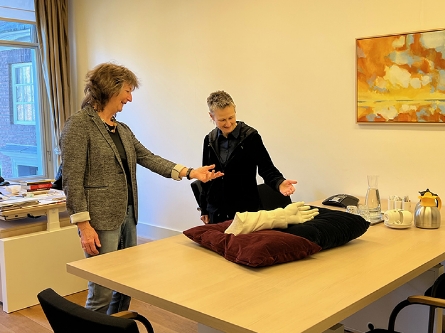
The work of art by Rini Hurkmans shows the expressiveness of the arm of the Pietà, as a stand-alone object after the vandalism. It reminds us of the whole of which the arm is a part. And of the aggression to which the sculpture has been exposed. But it also shows that the gesture it conveys can be as effective as ever. For more than half a year, the arm was part of my working environment at the KNAW. It was a time when we often had to work at home. But every time I entered my office, I saw the arm with the outstretched hand on the red velvet cushion. And then I thought of Michelangelo, of the Buddhas of Bamiyan, and of the fact that even out of aggression towards images sometimes something good may arise. Because people enter into relationships with art.
I took over A Personal Gesture from Liesbeth Bik. The person who taught me a lot about art is my colleague from Leiden, the art historian Kitty Zijlmans. To her, I hand over A Personal Gesture.
* See: the advisory trajectory for controversial monuments.
** Joke de Wolf, ‘Pijn om het verloren werk van Prymachenko’, Trouw 9 maart 2022, p. 15.
©Ineke Sluiter, maart 2022
September 14, 2021 - March 8, 2022: the arm is with Ineke Sluiter.